


Page 2 - SAMRC Summative Report 2025-26
P. 2
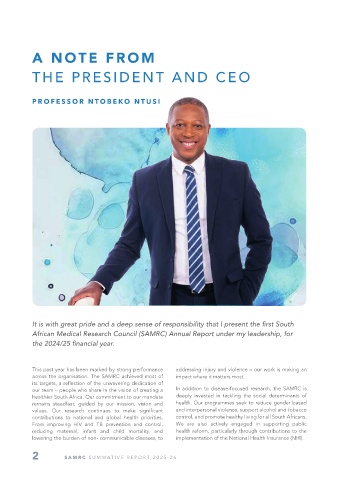
A NOTE FROM THE PRESIDENT AND CEO


                                                               As an organisation tasked with generating evidence
                 The 2025/2026 financial                       to address South Africa’s quadruple burden of
                                                               disease, maternal, newborn and child health, HIV
                 year has reinforced a                         and tuberculosis, non-communicable diseases, and
                                                               interpersonal violence, we are continuously refining
                 defining shift in how we                      how we produce knowledge that is both responsive

                 pursue our mandate                            and actionable.
                 as the SAMRC, with                            Our  theme  for  the  2025/2026  Annual  Report is
                                                               “Artificial Intelligence in medical and health research”
                 the visible increasing                        to highlight that AI is fast becoming a core pillar of
                 integration of artificial                     future health innovation in South Africa and abroad.
                                                               Across the SAMRC’s research units and centres,
                 intelligence (AI) and                         we are leveraging data-driven tools to strengthen
                 advanced technologies                         disease surveillance, improve predictive modelling,
                                                               and accelerate the translation of research into policy-
                 into the fabric of health                     relevant insights. From epidemiological modelling
                                                               within  our  HIV  and  TB  research  platforms  to  data
                 research.                                     analytics supporting non-communicable disease
                                                               studies and digital tools enhancing violence and injury
                                                               surveillance, these advancements are expanding
                 PROFESSOR                                     our ability to interrogate complex health challenges
                 NTOBEKO NTUSI                                 with greater precision and speed. Importantly, the
                                                               adoption of AI enhances our capacity; it does not
                                                               replace the foundational role of human expertise.
                                                               Scientific  inquiry  remains  inherently  human:  it  is
                                                               driven by  critical  thinking, ethical  judgement, and
                                                               contextual understanding.
                                                               AI augments this process by enabling researchers to
                                                               work more efficiently with large, complex datasets,
                                                               identify  patterns  that  might otherwise  remain
                                                               hidden, and generate insights that inform targeted
                                                               interventions. However, it is our researchers, their
                                                               experience, discipline, and commitment to public
                                                               health, who ensure that these tools are applied
                                                               meaningfully and ethically within the South African
                                                               context, and this expertise ultimately extends more
                                                               broadly within the region and abroad. Within the
                                                               SAMRC, several research units are advancing the
                                                               application  of  AI  and  digital innovation  to  directly
                                                               support our mandate. Our burden of disease
                                                               research continues to evolve through improved data
                                                               integration and modelling techniques, strengthening
                                                               national health planning. Units focused on genomics
                                                               and infectious diseases are exploring computational
                                                               approaches to understand disease transmission and
                                                               treatment responses better. Similarly, our work in


            1           SA M R C  S U M M A T I V E R EP O R T 2 0 2 5 / 2 0 2 6

