


Page 154 - SAMRC AnnualReport 2025-26
P. 154
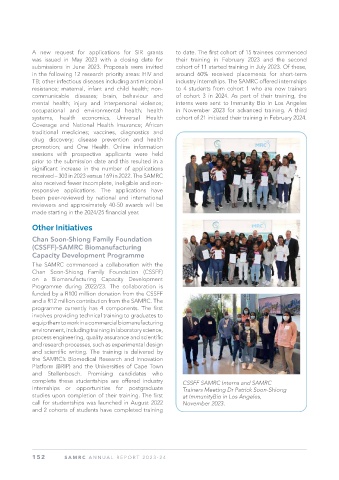
Genomics of Brain
                                                               Disorders Research Unit


                                                               UNIT DIRECTOR:
                                                               Prof. Soraya Seedat
                                                               sseedat@sun.ac.za


            Overview of the Research Unit                      Key Milestones and Achievements

            The Unit aims to identify genomic biomarkers for a   The Unit seeks to advance understanding and
            range of brain disorders (BDs) across the lifespan   improve prediction of BDs in African populations by
            using a systems biology approach informed          generating scalable, contextually relevant evidence
            by clinically derived data and multidisciplinary   to inform risk prediction, biomarker identification,
            expertise.  Its  research  goes  beyond  traditional   and the development of novel therapeutic targets
            clinical classifications of mental disorders to enable   for disorders prevalent in South Africa.
            the phenotyping and analysis of biologically valid
            cross-disorder subgroups and subtypes that may     A key strategic focus has been developing and
            better predict disease onset, progression, and     analysing multimodal datasets to support data-
                                                               driven,  AI-enabled  approaches  to  BD  research.
            treatment response.
                                                               The  Unit  has  made  significant  contributions  to
            This work is driven by translational neuroscience   genomic  research  through  its  Parkinson’s  disease
            research aimed at reducing the burden of BDs in    (PD)  programme,  including  conducting  the  first
            South Africa. The Unit employs innovative multi-   genome-wide association study of PD in southern
            omics, cognitive-affective, and brain-imaging      Africa. This work identified a novel PD susceptibility
            platforms to explore complex interactions among    locus  and  sex-specific  associations,  emphasising
            molecular, clinical, psychosocial, and environmental   the importance of including African populations in
            determinants  of  brain  health.  The  research    global genomic research and laying a foundation
            encompasses  both  molecular  and  clinical  fields,   for future biomarker discovery.
            with a strong focus on integrating biological      The Unit has also initiated research exploring the
            findings with contextual and environmental factors.  role of the exposome in neuropsychiatric risk.
                                                               Current studies integrate social, environmental, and
            The Unit’s research has provided new insights into
            the genetic and environmental factors affecting    biological dimensions of trauma to examine how
            the risk and progression of BDs throughout life.   cumulative  exposures  influence  brain  health  and
            It  has  also  improved  understanding  of  disease   vulnerability to mental disorders in South African
            mechanisms in South African and wider African      populations.
            populations,  laying  the  groundwork  for  future   In  addition,  the  Unit  is  conducting  a  longitudinal
            development of effective, culturally suitable, and   multimodal study using brain imaging, behavioural
            contextually relevant treatments. Additionally, the   assessments, and prospective data collection
            Unit’s findings may assist in integrating genomic data   to  investigate  how environmental  factors  shape
            into clinical practice and help improve approaches   emotion regulation and mental health outcomes
            to diagnosis, prevention, and intervention. Through   at behavioural and neurobiological levels. The
            its research-enabled framework, the Unit promotes   research aims to identify mechanisms of resilience
            cutting-edge investigation and generates evidence   that can inform scalable and culturally grounded
            to better understand vulnerability and protective   interventions. By combining advanced statistical
            factors linked to BDs.                             methods and machine learning with a rare


            152         SA M R C  A N N U A L R EP O R T 2 0 2 5 / 2 0 2 6

