


Page 29 - SAMRC Annual Performance Plan 2026-27
P. 29
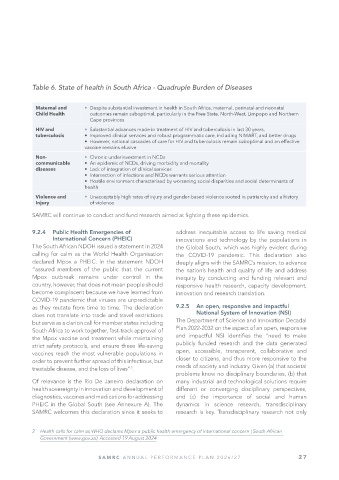
Table 6. State of health in South Africa - Quadruple Burden of Diseases


              Maternal and     •  Despite substantial investment in health in South Africa, maternal, perinatal and neonatal
              Child Health       outcomes remain suboptimal, particularly in the Free State, North-West, Limpopo and Northern
                                 Cape provinces
              HIV and          •  Substantial advances made in treatment of HIV and tuberculosis in last 30 years.
              tuberculosis     • Improved clinical services and robust programmatic care, including NIMART, and better drugs
                               • However, national cascades of care for HIV and tuberculosis remain suboptimal and an effective
                               vaccine remains elusive
              Non-             • Chronic underinvestment in NCDs
              communicable     • An epidemic of NCDs, driving morbidity and mortality
              diseases         • Lack of integration of clinical services
                               • Intersection of infections and NCDs warrants serious attention
                               • Hostile environment characterised by worsening social disparities and social determinants of
                               health
              Violence and     •  Unacceptably high rates of injury and gender-based violence rooted in patriarchy and a history
              Injury             of violence
            SAMRC will continue to conduct and fund research aimed at fighting these epidemics.


            9.2.4  Public Health Emergencies of                address inequitable access to life saving medical
                    International Concern (PHEIC)              innovations and technology by the populations in
            The South African NDOH issued a statement in 2024   the Global South, which was highly evident during
            calling for calm as the World Health Organisation   the COVID-19 pandemic. This declaration also
            declared Mpox a PHEIC. In the statement NDOH       deeply aligns with the SAMRC’s mission, to advance
            “assured members of the public that the current    the nation’s health and quality of life and address
            Mpox outbreak remains under control in the         inequity by conducting and funding relevant and
            country, however, that does not mean people should   responsive health research, capacity development,
            become complacent because we have learned from     innovation and research translation.
            COVID-19 pandemic that viruses are unpredictable
            as they mutate from time to time. The declaration   9.2.5  An open, responsive and impactful
            does not translate into trade and travel restrictions     National System of Innovation (NSI)
            but serve as a clarion call for member states including   The Department of Science and Innovation Decadal
            South Africa to work together, fast-track approval of   Plan 2022-2032 on the aspect of an open, responsive
            the Mpox vaccine and treatment while maintaining   and  impactful  NSI  identifies  the  “need  to  make
            strict safety protocols, and ensure these life-saving   publicly funded research and the data generated
            vaccines reach the most vulnerable populations in   open, accessible, transparent, collaborative and
            order to prevent further spread of this infectious, but   closer to citizens, and thus more responsive to the
            treatable disease, and the loss of lives” .        needs of society and industry. Given (a) that societal
                                               2
                                                               problems know no disciplinary boundaries, (b) that
            Of relevance is the Rio De Janeiro declaration on   many industrial and technological solutions require
            health sovereignty in innovation and development of   different or converging disciplinary perspectives,
            diagnostics, vaccines and medications for addressing   and (c) the importance of social and human
            PHEIC in the Global South (see Annexure A). The    dynamics in science research, transdisciplinary
            SAMRC welcomes this declaration since it seeks to   research is key. Transdisciplinary research not only


            2  Health calls for calm as WHO declares Mpox a public health emergency of international concern | South African
               Government (www.gov.za). Accessed 19 August 2024


                                    SAMRC ANNUAL PERFORMANCE PLAN 2026/27                                 27

