


Page 42 - SAMRC AnnualReport 2025-26
P. 42
Using  a  community-based  prospective  birth      In  addition,  data  collected  from  917  adult
            cohort, this project seeks to determine when and   participants on knowledge, attitudes, and practices
            how enteric antibiotic resistance (the resistome) is   related  to  antimicrobial  use are  being  used  to
            acquired early in life. The study further investigates   develop ethnographically relevant AMR awareness
            associations between the enteric resistome and     and educational packages for local communities.
            microbial, maternal, sanitation and hygiene, dietary,
            hydrometeorological, ethnographic, vaccination,    The second project investigates whether individuals
            treatment, and socio-economic factors.             living  with  HIV  who  are  initiated  on  the  standard
                                                               first-line  treatment  regimen  (tenofovir-lamivudine-
            Since 2023, newborn infants have been enrolled within   dolutegravir) may have had prior exposure to
            the  first  two  weeks  of  life  for  periodic  assessment   antiretroviral  therapy  (ART), and  how  undisclosed
            of enteric resistome development over a 24-month   exposure influences drug resistance development
            period. Preliminary metagenomic resistome data     and treatment outcomes, including viral suppression
            collected from 100 children at less than 17 days   and CD4+ cell count recovery.
            and again at six months after birth indicate that   To date, traces of tenofovir have been detected
            the  enteric resistome is acquired  very early in life   in the plasma of 127 out of 712 participants
            and  exhibits  significant  diversity.  These  findings   (17.8%) at first HIV diagnosis or among individuals
            from otherwise healthy children suggest potential   reporting no prior ART exposure at treatment
            implications for future clinical resistance patterns   initiation.  These  findings  suggest  the  need  for
            and the development of treatment guidelines.       more robust assessment protocols for individuals
                                                               entering  treatment  to  safeguard  the  efficacy  of
                                                               first-line  regimens  and  support  progress  toward
                                                               viral suppression targets among people receiving
                                                               treatment.

                                                               Building Capacity Through
                                                               Training, Mentorship, and Support

                                                               The Unit implemented several capacity development
                                                               initiatives during 2025/2026, including:

                                                                 › Proposal Writing Workshop for Biomedical
                                                                Research: Facilitated by Professor Bessong for
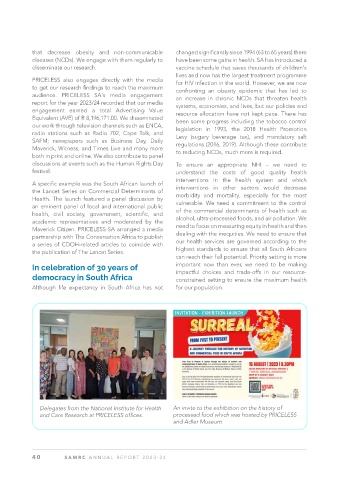
                Some members of the Antimicrobial               15 researchers and postgraduate students.
                Resistance and Global Health Research Unit
                during RedCap training.                          › Training on Evidence-Based Methods: Facilitated
                                                                by Professor Mark Engels and Lorenzo Bennie from
                                                                the Cochrane SA at the SAMRC. Twenty-eight staff
                                                                members and postgraduate students took part.
                                                                 › Research Electronic Data Capture (REDCap)
                                                                Training: Facilitated by Clive Sibiya (SAMRC), with
                                                                staff members and students trained.
                                                                 › Whole Genome Sequencing and Bioinformatics
                                                                Pipelines  Training:  Conducted on  15 and  22
                                                                August  2025  by  Drs  Idris  Njanje  and  Justine  Fri.
                                                                Staff members and postgraduate students were
                                                                trained to generate whole genomes of locally
                                                                relevant human pathogens.
                                                                 › Microbial  Molecular  Techniques  Training:
                                                                Conducted in 2025 by Drs Idris Njanje and Justine
                Mr Clive Sibiya RedCap Training Demonstration.
                                                                Fri for postgraduate students from the Department
                                                                of Plant and Soil Sciences.


            40          SA M R C  A N N U A L R EP O R T 2 0 2 5 / 2 0 2 6

