


Page 295 - SAMRC AnnualReport 2025-26
P. 295
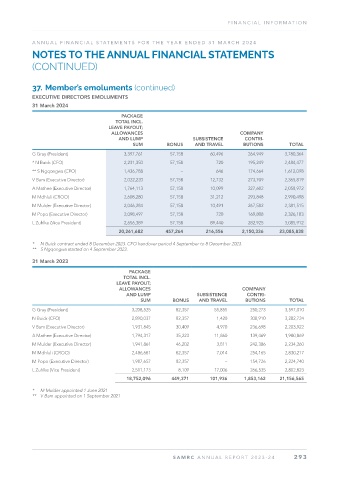
F I NAN C IAL  I N F O R MA T I O N


            ANNUAL FINANCIAL STATEMENTS FOR THE YEAR ENDED 31 MARCH 2026
            SIGNIFICANT ACCOUNTING POLICIES
            (CONTINUED)


                  1.9  Financial instruments – GRAP 104 (Previous policy applied in
                         comparative period) (continued)

                         Presentation
                         Interest relating to a financial instrument is recognised as revenue in surplus or deficit.

                         Dividends or similar distributions relating to a financial instrument or a component that is a financial
                         liability is recognised as revenue or expense in surplus or deficit.

                         Losses and gains relating to a financial instrument or a component that is a financial liability is recognised
                         as revenue or expense in surplus or deficit.

                  1.10  Statutory receivables

                         Identification
                         Statutory receivables are receivables that arise from legislation, supporting regulations, or similar means,
                         and require settlement by another entity in cash or another financial asset.

                         Carrying amount is the amount at which an asset is recognised in the statement of financial position.

                         The cost method is the method used to account for statutory receivables that requires such receivables to
                         be measured at their transaction amount, plus any accrued interest or other charges (where applicable)
                         and, less any accumulated impairment losses and any amounts derecognised.

                         The transaction amount (for purposes of this Standard) for a statutory receivable means the amount
                         specified in, or calculated, levied or charged in accordance with, legislation, supporting regulations, or
                         similar means.

                         Recognition
                         The entity recognises statutory receivables as follows:

                         •  if the transaction is an exchange transaction, using the policy on Revenue from exchange transactions;
                         •  if the transaction is a non-exchange transaction, using the policy on Revenue from non-exchange
                            transactions (Taxes and transfers); or
                         •  if the transaction is not within the scope of the policies listed in the above or another Standard of
                            GRAP, the receivable is recognised when the definition of an asset is met and, when it is probable
                            that the future economic benefits or service potential associated with the asset will flow to the entity
                            and the transaction amount can be measured reliably.

                         Initial measurement
                         The entity initially measures statutory receivables at their transaction amount.


                         Subsequent measurement
                         The  entity  measures  statutory  receivables  after  initial  recognition  using  the  cost  method.  Under  the
                         cost method, the initial measurement of the receivable is changed subsequent to initial recognition to
                         reflect any:

                         •  interest or other charges that may have accrued on the receivable (where applicable);
                         •  impairment losses; and
                         •  amounts derecognised.


                                                           SA M R C  A N N U A L R EP O R T 2 0 2 5 / 2 0 2 6  293

