
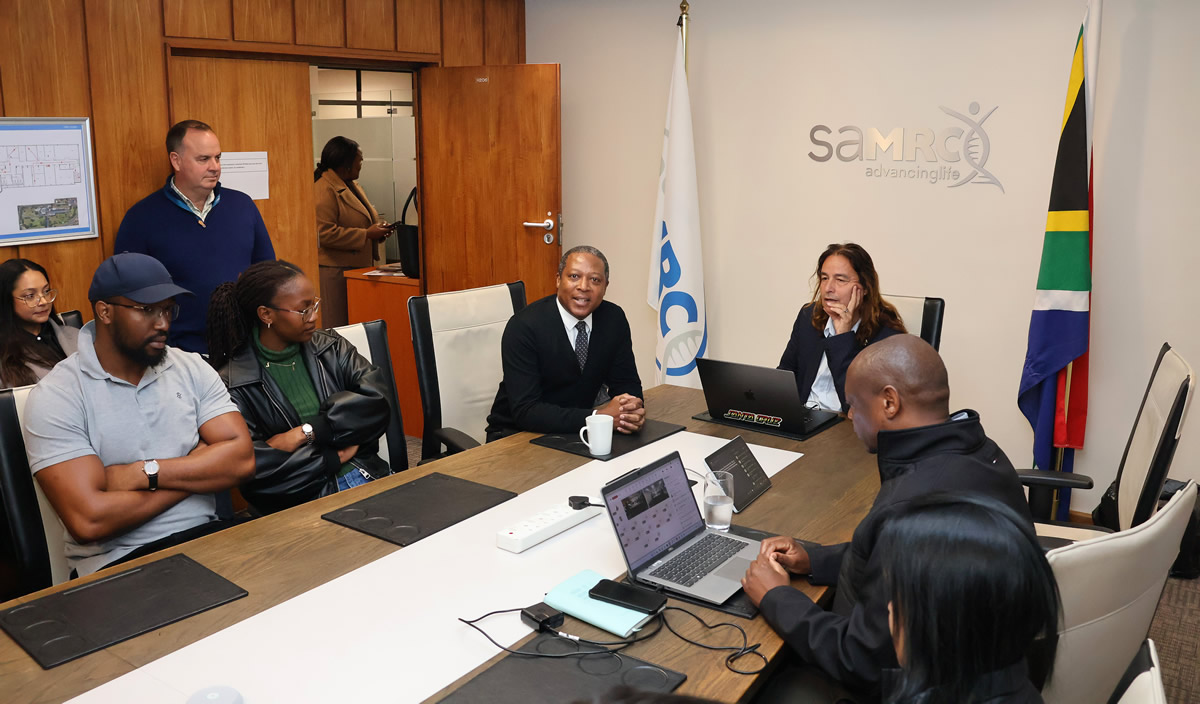
The South African Medical Research Council (SAMRC) recently hosted Professor Tulio de Oliveira, Director of the Centre for Epidemic Response and Innovation (CERI) at Stellenbosch University, for a President and CEO Lecture titled "Accelerating genomics-based surveillance for disease-causing pathogens in Africa."
The lecture showcased how Africa is increasingly leading global efforts in genomic surveillance, epidemic preparedness, data science and biotechnology innovation, while strengthening the continent's ability to respond rapidly to emerging public health threats.
Welcoming attendees, SAMRC President and CEO, Professor Ntobeko Ntusi, highlighted the longstanding partnership between the SAMRC and CERI, which has played a pivotal role in advancing genomic surveillance and research capacity across South Africa and the continent.
Prof de Oliveira reflected on the evolution of CERI from a genomics-focused research centre into a multidisciplinary hub integrating genomics, data science, artificial intelligence (AI), epidemic modelling, innovation and commercialisation.
"Our goal is not only to advance science, but to move science from the laboratory to industry and society where it can have a real impact," said Prof de Oliveira.
He highlighted the success of South Africa's Network for Genomic Surveillance, established through support from the SAMRC and the Department of Science, Technology and Innovation. The network played a critical role during the COVID-19 pandemic and has since expanded its focus to include pathogens such as HIV, tuberculosis, influenza and other emerging infectious diseases.
A key theme of the lecture was the importance of building sustainable African capacity. Prof de Oliveira noted that CERI has trained nearly 1,000 fellows from more than 50 African countries in genomic surveillance, bioinformatics and epidemic response.
"One of the most rewarding measures of impact is seeing our fellows return to their countries and take up leadership positions in public health, research and government," he said. "Many are now leading national institutes, surveillance programmes and innovation initiatives across Africa."
The lecture also demonstrated how AI and advanced data science are transforming disease surveillance. By combining genomic information with satellite imagery, climate data, mobility patterns and ecological information, researchers can identify areas at increased risk of disease outbreaks before they occur.
Prof de Oliveira shared examples of how these approaches helped predict and detect dengue outbreaks in West Africa and supported preparedness efforts against chikungunya in Mauritius. In both cases, early warning systems, genomic surveillance and collaboration with local health authorities enabled faster public health responses.
"We are moving from simply reacting to outbreaks to anticipating where they may occur and helping countries prepare before they happen," he said.
The presentation also highlighted CERI's role in supporting outbreak responses across Africa, including recent efforts involving hantavirus and Ebola. Through a network of trained fellows and partnerships with governments, the World Health Organization and the Africa Centres for Disease Control and Prevention, CERI has assisted more than 20 outbreak responses in 17 African countries over the past two years.
Prof de Oliveira emphasised that successful epidemic preparedness requires a One Health approach that recognises the interconnectedness of human, animal and environmental health.
"The emergence of infectious diseases is often linked to environmental and ecological changes. Understanding these connections is essential if we are to predict and prevent future outbreaks," he said.
Beyond surveillance, the lecture explored opportunities to strengthen Africa's biotechnology ecosystem and reduce dependence on global supply chains. Prof de Oliveira outlined initiatives supporting biotechnology start-ups, vaccine development and pharmaceutical innovation, including efforts to build local manufacturing capabilities and attract investment into African science-based enterprises.
Among these initiatives is SWEAT Africa, a festival that brings together researchers, startup founders, investors and the tech community to strengthen Africa's innovation ecosystem. The first edition took place in 2026 and was a resounding success, with the second edition set to take place on 16 and 17 March 2027.
He also spoke about the growing importance of science communication in combating misinformation and strengthening public trust in science.
"Science communication is critical," he said. "But effective science communication must be built on strong scientific evidence and careful preparation. Scientists need to engage with the public and policymakers to ensure evidence informs decision-making."
Closing the session, Prof Ntusi commended Prof de Oliveira and the CERI team for their contributions to global health security.
"The work being undertaken by CERI demonstrates the power of African science, collaboration and innovation. These efforts are not only strengthening our response to current health threats but are helping to build a more resilient future for the continent," said Prof Ntusi.
The lecture formed part of the SAMRC President and CEO Lecture Series, which brings leading scientists and innovators to share insights on addressing South Africa and Africa's most pressing health challenges.
Click here to watch the presentation by Prof Tulio de Oliveira