
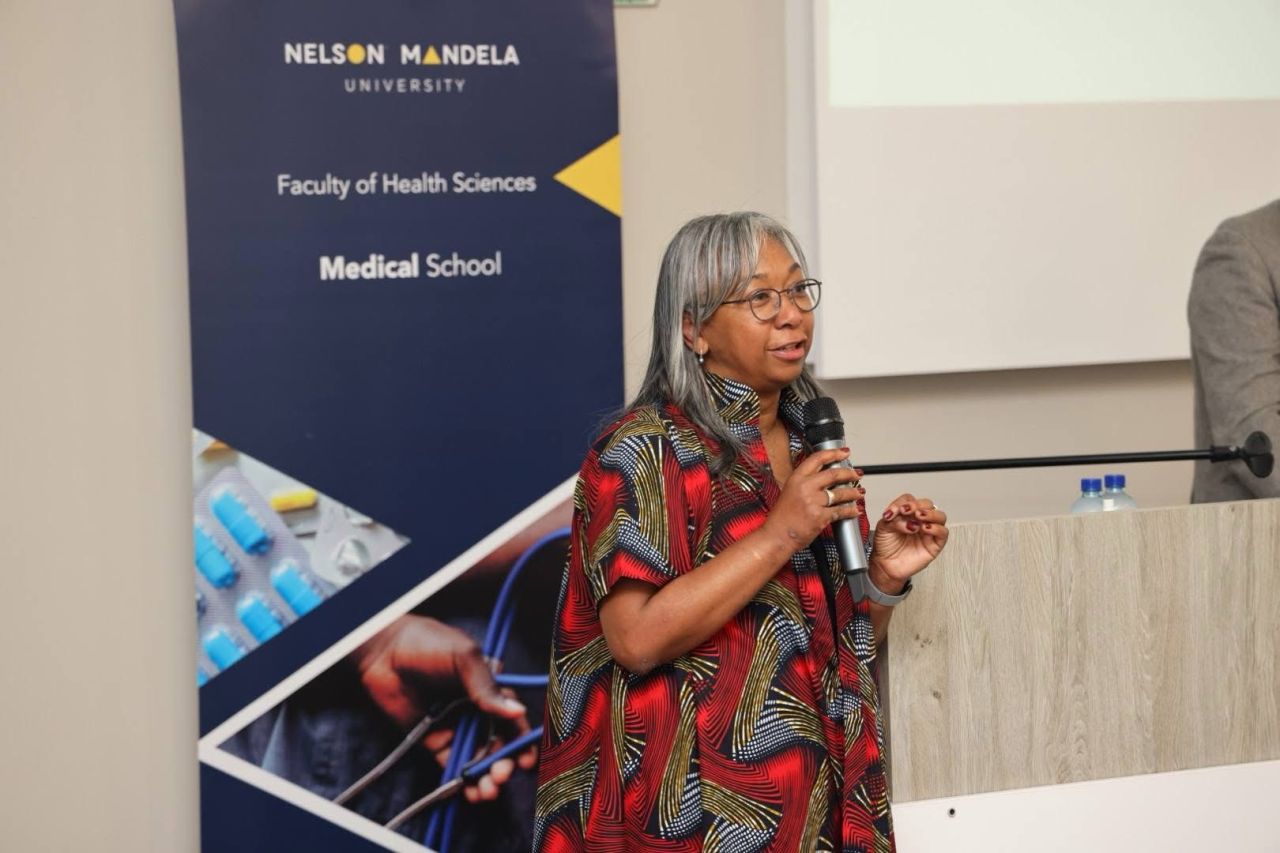
Health research must translate into better care for patients and communities, particularly those facing the greatest barriers to accessing services. This was the central message from South African Medical Research Council (SAMRC) Vice-President of Extramural Research and Internal Portfolio (ERIP), Prof Liesl Zühlke during a public lecture at Nelson Mandela University on 16 October 2026.
Presented at the Faculty of Health Sciences, her lecture entitled, “Leaving No One Behind: Congenital and Rheumatic Heart Disease as a Lens on Comprehensive Health Services”, marked her appointment as an Honorary Professor in the Department of Public Health, the first honorary professorship within the University’s Medical School.
Drawing on her experience as a clinician, researcher and public-health leader, Prof Zühlke used childhood heart disease to illustrate persistent inequalities in Africa. She highlighted how rheumatic heart disease can follow untreated streptococcal infections, while children with congenital heart disease face substantial disparities in survival and access to specialist care.
Addressing these challenges requires more than specialist treatment. She highlighted connected services spanning prevention, early diagnosis, primary healthcare, referral pathways, surgery and intensive care, supported by community health workers and social services. Childhood-onset heart disease, she argued, cannot be the responsibility of cardiologists alone.
Handheld echocardiography, artificial intelligence and digital health offer opportunities to improve detection and care, but technology alone cannot overcome inequity. Prof Zühlke called for reliable African datasets, stronger disease surveillance and registries, and practical referral systems. Appropriately trained health professionals closer to communities could also use focused heart ultrasound to support earlier detection and referrals.
A further priority was designing research for impact from the outset, rather than considering its use only after publication. Communities and people living with health conditions, whom she described as “experts by experience” should help drive research questions, priorities and interventions.
She highlighted SAMRC approaches to sharing research, including podcasts, plain-language summaries, youth engagement and multilingual health information. Effective communication, she stressed, starts with understanding how communities want to engage and assessing whether information changes knowledge, attitudes or practices.
Partnerships across disciplines and countries were another key theme, including training collaborations to strengthen paediatric cardiac care across Africa. Her Nelson Mandela University appointment offers further opportunities for collaboration, postgraduate training and supervision.
Reflecting on her own journey and the influence of mentors, Prof Zühlke linked scientific excellence with social justice and wider opportunity. Her message was clear: the value of research lies not only in the knowledge it produces, but in who benefits from it.
Watch here: https://www.youtube.com/watch?v=KTUN-E_mnig
Author
Zimasa Jam Jam
Science Writer & Editor
Corporate & Marketing Communications
E-mail: Zimasa.Jamjam@mrc.ac.za