
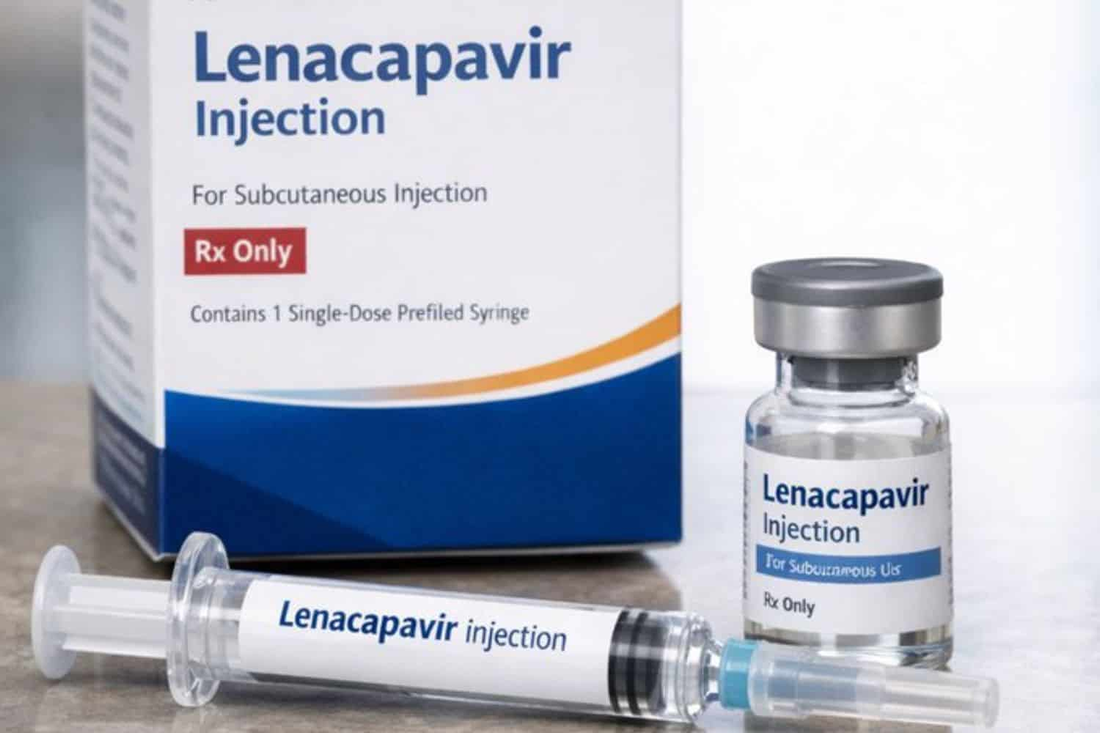
Compared to daily oral pre‐exposure prophylaxis (PrEP), lenacapavir reduces the number of new HIV infections by many more; causes slightly fewer serious unwanted effects; and, results in little to no difference in overall unwanted effects or risk of death. Lenacapavir likely causes more mild to moderate injection site reactions than oral PrEP.
These were the main findings of a Cochrane review part‐funded by the South African National Department of Health (NDoH) through the Evidence to Decision (E2D) Collaboration project (2024 − 2028). The E2D Collaboration is a partnership between the NDoH, the South African Medical Research Council and Stellenbosch University. The review was led by researchers from the Health Systems Research Unit of the SAMRC and was conducted in response to a priority question from the South African National Essential Medicines List Committee (NEMLC) to inform their decision-making processes.
Globally, there are still 1.3 million new HIV infections annually, with a disproportionate burden on young women and girls, especially in sub‐Saharan Africa, in which 63% of new infections occur. PrEP is a medicine taken by HIV‐negative people to reduce the risk of getting HIV. However, despite its demonstrated effectiveness, global uptake remains low, particularly in vulnerable populations, reaching only 16.5% of the UNAIDS 2025 target. Current PrEP options include daily oral (taken by mouth) medications and injections given every two months. These are only effective if taken regularly. There is therefore an urgent need to develop and implement alternative, user‐friendly PrEP strategies, specifically long‐acting formulations that minimise reliance on daily dosing or frequent injections. Lenacapavir is a first‐in‐class capsid inhibitor that disrupts HIV replication at multiple stages, and only needs to be injected every six months.
“Lenacapavir requires fewer healthcare visits than oral PrEP, poses fewer adherence challenges and could therefore be an important PrEP choice to implement programmatically for people at risk of HIV acquisition,” said Sumayyah Ebrahim, Senior Scientist in the HSRU and joint lead author of the review. “The aim of our review was therefore to evaluate the benefits and harms of Lenacapavir for HIV PrEP compared to oral fixed‐dose combination PrEP products, long-acting injectable cabotegravir, placebo, or no prophylaxis.”
The review included two large randomised-controlled trials involving 8,660 participants. The first, conducted in South Africa and Uganda, included adolescent girls and young women (16 to 25 years) while the second, conducted in the USA, Brazil, Thailand, South Africa, Peru, Argentina and Mexico, included cisgender gay, bisexual and other men, transgender women and men, and gender‐nonbinary persons.
“The review found that when compared to oral PrEP, Lenacapavir results in a large reduction in new HIV infections at 52 weeks, with one HIV infection prevented for every 70 people receiving Lenacapavir rather than oral PrEP, or 14 fewer HIV infections per 1000 people treated with Lenacapavir,” explained Natasha Gloeck, Senior Scientist in the HSRU and joint lead author of the review. “Lenacapavir also results in a slight reduction in serious adverse events and little to no difference in adverse events compared to oral PrEP. Lenacapavir likely increases the risk of injection site reactions compared with oral PrEP, but discontinuation of Lenacapavir in the included trials due to injection site reactions was rare. There is little to no difference in mortality between Lenacapavir and oral PrEP. There was also a large reduction in HIV incidence in the Lenacapavir study arms compared to background HIV incidence in the screened populations.”
The review authors also emphasised the need for ongoing research, including increased understanding of the cost implications of rolling out Lenacapavir and the implementation challenges. More information and data are needed on the risks in pregnant women and in at-risk populations, including injecting drug users, cisgender women, men who have sex with men and gender‐diverse persons, some of which are already being studied in current trials.
The full review is available at: https://www.cochranelibrary.com/cdsr/doi/10.1002/14651858.CD016347/full