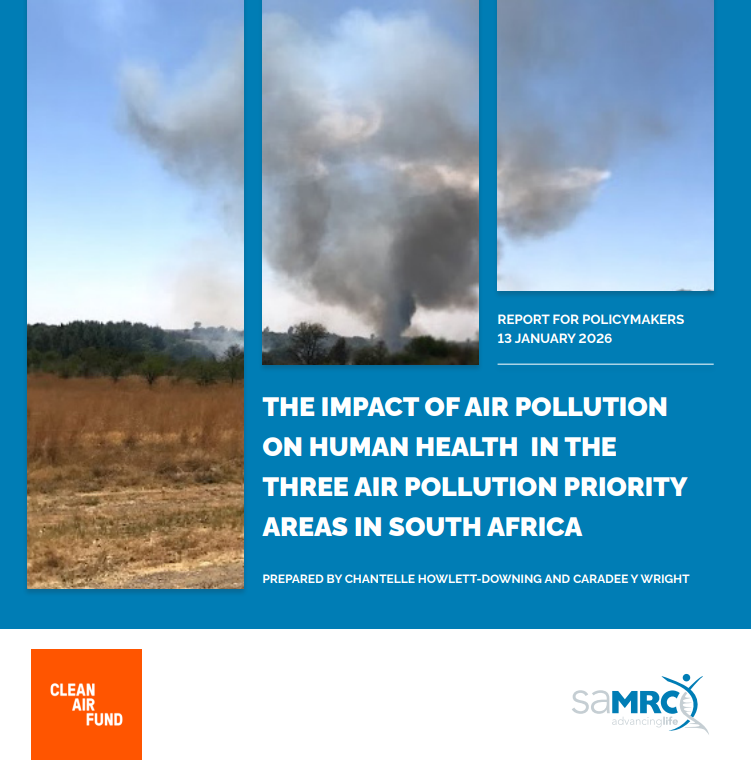
New SAMRC and Clean Air Fund Project Report Launched to Provide an Evidence-Policy-Action Pathway for South Africa’s Air Pollution Priority Areas
A new research and policy initiative aimed at providing a pathway to reducing the severe health impacts of air pollution in South Africa’s most affected regions has been officially launched by the South African Medical Research Council (SAMRC), with support from the Clean Air Fund.
The project builds on robust epidemiological evidence generated through a multi-site SAMRC study examining the health impacts of ambient air pollution in South Africa’s three Air Pollution Priority Areas: the Highveld, the Vaal Triangle, and the Waterberg–Bojanala region. These areas consistently exceed national air quality standards and are home to large, vulnerable populations exposed to harmful pollutants such as fine particulate matter (PM₂.₅), nitrogen dioxide (NO₂), and sulphur dioxide (SO₂).
Findings synthesised in the project’s newly released policy brief, short policy report and full report show strong and consistent links between air pollution exposure and increased mortality and morbidity, particularly from respiratory diseases, tuberculosis, and pneumonia. For every 10 µg/m³ increase in PM2.5 mortality risk increases by 14–19%.
Children, older adults, and communities facing socio-economic disadvantage are shown to bear a disproportionate share of this health burden. Winter months emerge as a period of especially high risk, underscoring the combined effects of industrial emissions, household fuel use, and meteorological conditions.
The project aims to translate this growing body of evidence into action by emphasising the need for stronger enforcement of air quality standards, expanding monitoring and data transparency, and integrating air pollution considerations into health system preparedness and energy policy. It also seeks to inform early warning systems for severe pollution episodes and promote cleaner household energy transitions.
Professor Caradee Wright, Chief Specialist Scientist at the South African Medical Research Council and co-lead investigator, together with Dr Chantelle Howlett-Downing, on the project, emphasised the urgency of action: “The evidence is clear that air pollution in South Africa’s Priority Areas is causing preventable illness and premature death. This project is about moving from data to impact, ensuring that scientific findings directly inform policy, strengthen health system responses, and ultimately reduce the burden of disease linked to poor air quality.”
The initiative aligns with national development, climate, and health priorities, and contributes to broader efforts to reduce health inequities while supporting sustainable development and cleaner air for all South Africans.
The full report can be downloaded from this link: https://www.samrc.ac.za/research-reports/report-policymakers-impact-air-pollution-human-health-three-air-pollution-priority?type=research-report&menu=intramural-research-units&menu-item=environment_and_health
Media enquiries:
Yolanda Phakela
Public Relations Manager
Yolanda.phakela@mrc.ac.za
About the project
The project is supported by the Clean Air Fund and is based on a multi-site epidemiological study conducted by the South African Medical Research Council, focusing on air pollution and health outcomes in South Africa’s designated Air Pollution Priority Areas.