
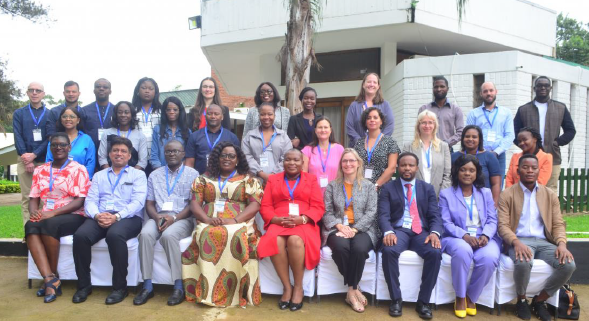
A collaborative project between South Africa, Norway, Malawi and Nigeria was undertaken to help strengthen national health evidence systems, using lessons from global evidence to adapt treatment and care to adequately serve the needs of local populations.
The Global Evidence, Local Adaptation (GELA) project aimed to bridge the gap between global research and national child-health policies in Malawi, Nigeria and South Africa. GELA brought together Ministries of Health, clinicians, researchers and civil society as equal partners in developing guidance. This collaboration ensured that recommendations were not only evidence-based but also feasible, equitable, and tailored to local contexts. Most recommendations were adapted from existing guidance while also advancing new methods for contextualisation in low- and middle-income settings.
Over the past three years, the consortium has completed comprehensive clinical, qualitative, and economic evidence syntheses and produced peer-reviewed publications as well as four country-specific recommendations on priority child-health topics namely enteral feeding, infection prevention, family-centred post-discharge care, and care for preterm and low-birthweight newborns. These were published on an open digital platform (MAGICApp) with clear summaries and infographics for healthcare workers and policymakers.
“Whenever you're making recommendations for care, there must be evidence synthesis underpinning that. Guidelines package the evidence and present recommendations to healthcare decision makers,” said Prof Tamara Kredo, Director of the Health Systems Research Unit at the South African Medical Research Council. “Healthcare practitioners, policymakers, patients and the public are all stakeholders of healthcare – for patients and the public it means making decisions about their own health.”
Prof Kredo said that guideline formulation is a complex process. “It involves packaging tons of information into what should be quite simple statements. And that’s not easy to do. But we were driven to address issues around the strengthening of evidence and informed decision making, and child health was chosen as the main area of work,” she added.
The guideline methods were underpinned by GRADE-ADOLOPMENT, an evidence-to-decision framework-based approach to adopt, adapt or create contextualised recommendations from source guidelines and evidence syntheses.
“We also wanted to maximise research-evidence uptake by increasing the capacity of researchers and decision makers to inform local guidelines. There's a lot of work that needs to happen, and I think we are best placed to decide and work out what work best in our settings.”
Beyond producing guidelines, GELA strengthened national evidence systems, trained early-career researchers, and fostered durable academic–government partnerships. It also created a regional community of practice, a network equipped to sustain evidence-informed decision-making after the project’s completion, with potential for expansion to other countries as future funding opportunities arise.
Presentation
Global Evidence, Local Adaptation (GELA) Project – advancing methods for guideline adaptation in Malawi, Nigeria, and South Africa: Prof. Tamara Kredo, Dr. Emmanuel Effe, Dr. Nyanyiwe Mbeye, Solange Durao
Video